
First published in Butterworths Journal of International Banking and Financial Law January edition 2026: Feature article by author Jacqueline Cook, senior finance knowledge lawyer at Mills & Reeve LLP.
Jacqueline Cook, senior finance knowledge lawyer at Mills & Reeve and member of the Cape Town Convention Academic Project, looks at the current status of the MAC Protocol to the Cape Town Convention on International Interests in Mobile Equipment. With special thanks to William Brydie-Watson, legal officer at UNIDROIT and Duarte Pedreira, TF COP Task Force chair.
Key points:
- The MAC Protocol will protect security interests, leases and conditional sales of certain MAC equipment making them enforceable if:
- the debtor is in a Contracting State; and
- it is then registered in the International Registry.
- The MAC Protocol is back on the agenda for UNIDROIT and TF COP – five states need to ratify it to bring it into force.
- As an extension to the Cape Town Convention family of treaties over high value moveable assets “… the MAC Protocol has the potential to transform equipment finance in the mining, agriculture and construction sectors across the world …”.
- It has been identified as one solution to encourage lending to SMEs internationally.
Why is a new global framework needed for financing in mining, agricultural and construction sectors?
Financing certain high value equipment needed in the mining, agricultural and construction (MAC) sectors has been constrained in some developing markets, due to:
- the lack of lending appetite;
- the expense of taking security over certain assets; and
- the difficulty of enforcing security quickly on default.
The result has meant that some businesses in the MAC sectors have been unable to access financing to purchase modern, high value equipment to improve their productivity and compete in the marketplace.
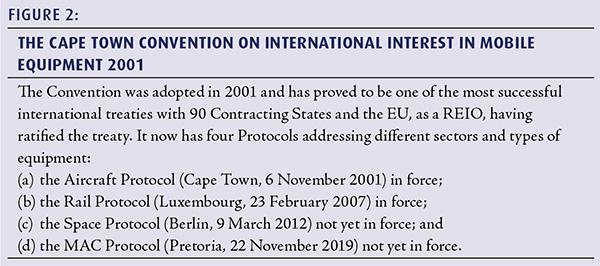
Over a number of years, the International Institute for the Unification of Private Law (UNIDROIT) along with industry bodies, academics and country representatives has been working to improve the position for asset-based financing by providing a global legal framework to protect security interests, leases and conditional sale agreements of MAC equipment by developing the Protocol to the Cape Town Convention (Convention) on International Interests in Mobile Equipment on Matters Specific to Mining Agricultural and Construction Equipment (MAC Protocol). Although signed in Pretoria, South Africa on 22 November 2019, the COVID-19 pandemic delayed the uptake in ratification of the MAC Protocol, however, this is now back on the agenda, with Paraguay being the first state to ratify it in 2024.
“As an ambitious expansion of the most successful international commercial law treaty in history, the MAC Protocol has the potential to transform equipment finance in the mining, agriculture and construction sectors across the world, with the majority of economic benefits forecast to flow to developing countries and emerging markets.” (William Brydie-Watson, UNIDROIT, November 2025)
The MAC Protocol should give financiers and equipment lessors the protection and confidence to grant credit in jurisdictions where they are not currently active and provide financing at lower rates in others where they are active, considering that independent studies have stated:
- the value of equipment within the scope of the MAC Protocol traded globally is US $148bn per year (UN COMTRADE 2023 data); and
- the MAC Protocol would “have a positive impact of US $23 billion on GDP in developing countries and of US $7 billion in developed countries” per year (Warwick Economics and Associates, MAC Protocol Economic Assessment, 2018).
What is the MAC Protocol?
The MAC Protocol is the fourth protocol to the Convention and extends the Convention rights and protections for security interests, leases and conditional sale agreements granted over certain classes of mining, agricultural and construction equipment making them enforceable internationally. However:
- the debtor has to be situated in a Contracting State; and
- the security, lease or conditional sale has to be registered in the relevant International Registry as an international interest.
“The debtor¹ is situated in any Contracting State: (a) under the law of which it is incorporated or formed, (b) where it has its registered office or statutory seat, (c) where it has its centre of administration; or (d) where it has its place of business.” (Art 3 Convention)
Even if the creditor is in a non-Contracting State, it will have the ability to access and rely on the Convention and MAC Protocol.
What MAC equipment is covered?
Any equipment listed in Annex 1 – Mining Equipment, Annex 2 – Agricultural Equipment and Annex 3 – Construction Equipment, may be the subject of an international interest irrespective of any intended or actual use (Art II MAC Protocol).
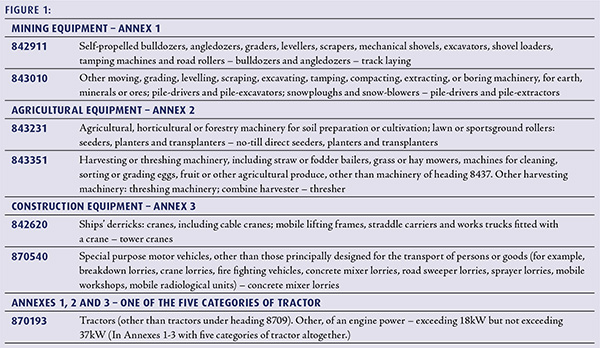
The MAC Protocol Committee of Governmental Experts and the Preparatory Commission for the establishment of the International Registry chose 56 HS Codes² to determine which equipment falls within scope. These HS codes were proposed by governments in consultation with their domestic industries, and approved based on whether the relevant code covers equipment:
- used predominantly in the MAC sectors (not for general use, like trucks);
- primarily used in the field (not for refining or processing, etc);
- primarily of high value; and
- which is primarily complete, rather than parts.
Fourteen HS Codes are common to all Annexes, namely bulldozers, angledozers, mechanical shovels, dumpers for off highway use and five grades of tractor. See Figure 1 opposite for examples.
What is the benefit of creating an international interest over MAC equipment?
The MAC Protocol regime will work as an alternative to domestic secured transaction laws providing an additional financing mechanism. It will aid enforcement of cross border security where the creditor and debtor are based in different jurisdictions, and where the MAC equipment may be transported across borders while the international interest is in place.
An international interest will take priority over a domestic security interest and the creditor will be able to enforce the international interest on the basis of the Convention rights and MAC Protocol.
The secured creditor, lessor or conditional seller of uniquely identified MAC equipment, (each referred to as the “creditor”) of an international interest, will have access to the remedies under the MAC Protocol and Convention if the debtor fails to meet its obligations, becomes insolvent or enters into any insolvency proceedings. The debtor should, however, consent to these remedies in the security agreement or lease.
The creditor will have a right to
“(a) take possession or control of any object charged to it; (b) sell or grant a lease of any such object; (c) collect or receive any income or profits arising from the management or use of such object; or alternatively, apply for a court order” (Art 8 Convention) authorising these actions.
The creditor may procure the export or physical transfer of the MAC equipment from the territory in which is it located (Art VIII MAC Protocol). The creditor can sell or lease the MAC equipment subject to the international interest once it has given notice of 14 or more days to the debtor. Sums received by the creditor from the proceeds of use, lease or sale should then be applied towards discharge of the secured obligations under the security agreement.
In the absence of any default, the debtor is “entitled to quiet possession and use of the equipment”. So, the method of granting security must enable the equipment to be in the possession of, and can be used by, the debtor while the international interest is in place, so it can put the equipment to use in its production and performance or to improve infrastructure.
Any security interest or lease should also cover “all installed, incorporated or attached accessories, components and parts and all data manuals and records” relating to it, so it tracks the definition in the MAC Protocol Art I(2) in the drafting of the security document.
It will be simpler and more cost effective for states to implement the MAC Protocol by becoming a Contracting State, than completely overhauling their domestic law on taking security and how that would be recognised and enforced internationally.
How will registration of international interests on MAC equipment work?
At the date of writing, the appointment of the Registrar to run the International Registry for MAC Equipment is due to be announced in December 2025, following a long and careful international procurement process by the Preparatory Commission, based on OECD and UN best practices.
Draft Regulations have already been published and will be finalised with the help of the Registrar once appointed. The Regulations Working Group has made recommendations on how to identify each object of MAC Equipment against which security, a lease or conditional sale agreement could be registered. The main identifying feature will be the Manufacturer’s Serial Number (MSN). However, there is no worldwide methodology for creation and application of the MSN, so there could be ambiguities or duplicates arising where manufacturers use the same or similar alphanumeric codes. The Regulations will also require “such additional information … to ensure the uniqueness … necessary and sufficient to identify the object” (Art XVII MAC Protocol). So what is that likely to mean in practice? From the set of Baseline Regulations for the International Registry for the MAC Protocol, (March 2024), s 5 sets out the information about the object required to effect registration, including:
“the ISO-compliant serial number assigned to the object by the manufacturer, if it has one; or
if not, a non-ISO-compliant alphanumeric serial number assigned to the object by the manufacturer; and
- the brand name for the equipment, or if unavailable, the name of the manufacturer;
- the manufacturer’s generic model designation; and
- one other item of descriptive information, if required by the Procedures.”
The Registry will be a modern electronic register online only and accessible 24 hours a day for seven days a week, charging a low registration fee. Each Contracting State will set up an entry point for access to the register and anyone effecting a registration will need an account to do so. One party would usually effect the registration on the basis of consent from the other in writing (Art 20 Convention).
Searches at the International Registry for MAC equipment will initially be done using the object’s MSN by electronic means only for a “priority” or an “informational” search to produce a list of close matches. A priority search will give a date for a prospective international interest, which can then be used as the date of registration (Art 19.4 Convention) when an international interest is created.
What is the current status of the MAC Protocol?
Five states are needed to ratify the MAC Protocol before it comes into force. At the date of writing, only Paraguay has ratified the MAC Protocol, (27 November 2024) and the following states having signed it: Congo, Gambia, Nigeria and Paraguay (22 November 2019), United States of America (1 October 2022) and the European Union (as a Regional Economic Integration Organisation (REIO)) (20 September 2022), so it is not yet in force.
UNIDROIT is involved in roadshows globally to aid implementation and encourage ratification. Brazil, China and Japan are at initial stages of consideration, with Japanese industry instructing its own economic assessment on how the MAC Protocol may benefit the Japanese economy. Kenya and Mauritius also have the MAC Protocol under consideration. The UK, Germany and the US together with UNIDROIT and the MAC Working Group (representing private sector stakeholders) form the current Ratification Task Force to encourage further action and Australia and Japan may also join them. With interest from the Organisation for Economic Cooperation and Development, the European Bank for Reconstruction and Development, the Asian Development Bank (ABD), the World Bank Group, the Asia Pacific Economic Cooperation and the East African Community, getting to that magic figure of five contracting states should be achievable in the relatively near future.
How does the MAC Protocol fit into the current global economic climate?
We can look at this from a number of angles.
- Each item of MAC equipment listed in the Annexes is expected to be worth anything from US $20,000 upwards. This covers a wide range of equipment needed by anything from large projects companies to the likes of SME farming entities or construction companies. As this could amount to US $148bn³ worth of MAC equipment available each year, this is not an insubstantial market!
- Financial institutions are much more aware of the impact of their lending decisions on ESG goals set against the background of the 17 United Nations Sustainable Developments Goals (SDGs). UNIDROIT highlights the following which states could improve upon by implementing the MAC Protocol:
- SDG 2: Zero hunger;
- SDG 7: Affordable and clean energy;
- SDG 9: Industry Innovation and infrastructure;
- SDG 11: Sustainable cities and communities; and
- SDG 12: Responsible consumption and production.
- The launch of Trade Finance Conference of Parties (TF COP) on 3 July 2024, has gathered a group of interested parties including, multilateral and development banks, financiers, credit insurers, lawyers and fintechs committed to taking action to reduce the global trade finance gap, estimated recently by the ADB to have stabilised at US $2.5trn (TF COP report of meeting on 28 October 2024, December 2024).
The ratification and use of the MAC Protocol could improve access to credit to supply machinery and equipment needed to improve food production and agricultural practices, to expand infrastructure and to make some impact on reducing the trade finance gap.
“Under the banner of TF COP, the industry agreed to converge its collective efforts to eliminate the trade finance gap by 2040. One of the key solutions streams identified to achieve this goal was the creation, dissemination, and adoption of innovative legal frameworks, which encourage lending to SMEs by creating certainty in terms of the appropriateness of collateral structures, which are designed to benefit both borrowers and lenders. The MAC Protocol strikes this at its core and is, therefore, a very welcome innovation .” (Duarte Pedreira, TF COP, November 2025).
Is it time to act?
The legal framework of the Convention is already in place. Consequently, only four more states need to take action to ratify the MAC Protocol and become Contracting States. That will then give the green light to expand the use of international interests to equipment such as tractors, cranes, angledozers, bulldozers, mechanical shovels, seed spreaders, balers and cranes, by registering them in an efficient electronic accessible International Registry, providing debtors the credit needed and giving creditors the protection and ability to enforce rights across borders.
With the changing economic climate and the need for: (i) food security; (ii) improved food production; (iii) development of infrastructure and sustainable energy supplies in developed and developing markets, the MAC Protocol is an alternative route to give creditors and lessors confidence to open credit and improve funding in these markets.
Further reading:
- The interaction between the MAC Protocol to the Cape Town Convention and domestic law (2020) 2 JIBFL 112.
- Financing mining, agriculture and construction equipment: the Fourth Protocol (2019) 1 JIBFL 28.
- Lexis+® UK: Journals: Uniform Law Review: Complexities arising from the expansion of the Cape Town Convention to other sectors: the MAC Protocol’s challenges and innovative solutions.
¹ The term “debtor” as used in the Convention means a “chargor under a security agreement, a conditional buyer under a title reservation agreement, and a lessee under a leasing agreement” whether or not there is an option to purchase.
² HS Codes are the Harmonised System Commodity Description and Coding System produced by the World Customs Organisation (WCO) used for worldwide import and export of goods for the application of tariffs and customs laws.
³ Information provided by UNIDROIT from UN COMTRADE data 2023.
Our content explained
Every piece of content we create is correct on the date it’s published but please don’t rely on it as legal advice. If you’d like to speak to us about your own legal requirements, please contact one of our expert lawyers.