
Individuals
UK tax residence is determined in accordance with the UK’s statutory residence test (SRT).
The SRT comprises a series of tests:
- An individual is resident in the UK in a tax year if they meet any of the ‘automatic residence tests’
- If the individual doesn't meet any of the ‘automatic residence tests’, the ‘automatic non-residence tests’ must be considered next
- If the individual doesn't meet any of the ‘automatic residence tests’ or any of the ‘automatic non-residence tests’, the ‘sufficient ties test’ will determine their UK tax residence status
The UK tax year runs from 6 April to 5 April. If an individual arrives in/leaves the UK part-way through a tax year, it's possible that they will be UK tax resident for only part of the tax year. In these circumstances, an individual may be eligible for ‘split year’ treatment which determines how they are to be taxed in the UK.
As the tax years of other countries are based on different dates, an individual can be resident in multiple jurisdictions simultaneously, or not tax resident anywhere, for a period of time. Where an individual is dual tax resident, a double tax treaty between the UK and the other country may apply to determine which country has ‘primary’ taxing rights, to potentially prevent the same income from being taxable in both countries.
Companies
The basic rule is that companies incorporated in the UK are subject to UK corporation tax (the main rate for corporation tax is 25%) on their worldwide profits. However, where a foreign company’s 'central management and control' is in the UK, its profits will be within the scope of UK corporation tax.
The test for determining 'central management and control' is based on English case law and it is broad and fact specific, but includes factors such as:
- Whether key strategic decisions are taken inside or outside the UK
- The residence of the company’s directors
- The autonomy of the directors and the control of any parent company
Where foreign companies have a 'permanent establishment' in the UK, the profits derived from that UK ‘permanent establishment’ will be within the scope of UK corporation tax.
Non-UK domiciled, UK residents
Pre-6 April 2025
Eligible UK resident, non-UK domiciled individuals (RNDs) can currently elect (with the current 2024/25 being the final tax year in which they may do so) to be taxed under a favourable income tax and capital gains tax regime known as the ‘remittance basis of taxation’.
RNDs who elect to be taxed on the remittance basis of taxation pay UK tax on:
- any of their income and gains which arise/accrue in the UK, and
- any of their foreign income and gains which they, or a 'relevant person', brings (or 'remits') to the UK, even if that remittance occurs in a later tax year
Domicile is a uniquely English, common law concept and transcends nationality, residence and ethnicity, and is tied to where an individual considers to be their ‘permanent home’. It's distinct from the concept of domicile in foreign countries, which typically considers domicile to be the place of abode.
The concept is relevant to various aspects of UK law, and is currently a connecting factor for UK tax purposes.
The UK Government has announced the abolition of the concept of domicile as a connecting factor for UK tax purposes and the remittance basis of taxation, from 6 April 2025.
From 6 April 2025
The ‘remittance basis of taxation’ will be replaced with a new simplified foreign income and gains regime (FIG regime). Under the FIG regime, eligible persons will not be taxed on any of their overseas income and gains for up to four tax years from their first year of UK residence.
In this period, they'll be able to bring income and gains into the UK without any charge to UK tax. After this period has ended, all income and gains, wherever arising in the world, will be subject to tax in the UK.
Transitional rules may apply to encourage individuals to remit their untaxed, pre-April 2025 foreign income and gains to the UK.
FIG regime – eligibility criteria
The FIG regime is available to individuals who have been non-UK resident for 10 consecutive tax years (including individuals born in the UK, for example British expatriates who have been resident in other countries). There will be no annual or flat-rate charge to access the four-year FIG regime. The UK’s statutory residence test (see above) will be used to determine an individual’s UK tax residence, when determining their eligibility for the four-year FIG regime. If an individual is UK resident in only part of that four-year period, it won't be possible to extend their exempt period beyond four years (eg by carrying forward any ‘unused’ years to future tax years).
Current UK tax rates
UK tax won't apply to any foreign income and gains during the four-year period. After this period, income tax is charged at graduated rates, with higher rates of income tax applying to higher bands of income. Tax is charged on total income (from all earned and investment sources) as follows:
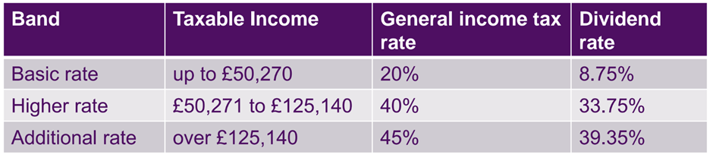
The ‘personal allowance’ is not shown in this table.
The rate for capital gains tax is up to 24% on gains from most assets, and generally 28% for “carried interest”.
Case study
“A” is domiciled and resident in France. She's an owner of a business incorporated and trading in France. She relocates to the UK and obtains a UK Visa (eg ‘global talent’ or UK expansion worker). As A hasn't been tax resident in the UK for the previous 10 tax years, A qualifies for the FIG regime. A’s French tax advisers confirm that upon moving to the UK, A ceased French tax residence.
Upon becoming UK resident in accordance with the SRT, A decides to sell her shares in the French business within the four-year period of the FIG regime, free of UK tax.
Article 14 of the UK/France double tax treaty provides that any such gain is taxable only in the UK where A is now resident (and not in France).
Subject to any anti avoidance rules under French law, A may return to France after the four-year period without incurring either UK or French tax on the sale of the business.
Our content explained
Every piece of content we create is correct on the date it’s published but please don’t rely on it as legal advice. If you’d like to speak to us about your own legal requirements, please contact one of our expert lawyers.