A GBE is confirmation by a sports governing body that a sportsperson migrating to the UK is established at the highest level and/or will make a significant contribution to the development of their sport at the highest level in the UK. A club can apply for a GBE for a player at any time during the season, provided they hold a valid Sponsor’s Licence. A Sponsor’s Licence, granted by the Home Office, allows a club to issue the player with a Certificate of Sponsorship.
Only clubs competing in the Premier League or English Football League are eligible for a Sponsor’s Licence. Clubs in other leagues within the football pyramid must ensure that any player they are looking to sign who is not a citizen of the UK (or Ireland if they are a senior player) has obtained a visa outside the GBE system which permits them to play football.
The governing body for every sport in the UK is required to publish ‘endorsement requirements’ which are effectively a set of criteria a sportsperson will be assessed against. If the sportsperson meets these criteria, they will be ‘endorsed’ by the governing body and a GBE will be issued to their employer who will issue the sportsperson with a Certificate of Sponsorship.
Once issued with a Certificate of Sponsorship, the player may then apply for his visa. Previously, there were two visa categories a player could apply for – the Tier 2 (Sportsperson) visa and the Tier 5 (Creative or Sporting) visa, although these were replaced by the International Sportsperson visa in October 2021
The main difference between the Tier 2 and Tier 5 visas in the previous regime was the length of their validity. Under the Tier 2 visa, the length of validity is three years or the length of the player's contract, whichever is shorter. Under the Tier 5 visa, the length of validity is one year or the length of the player's contract, whichever is shorter. This distinction has been retained by the International Sportsperson visa, which introduced short-term and long-term visas as successors to the Tier 5 and Tier 2 visas respectively.
The FA, being the governing body for football in England is responsible for providing GBEs to all migrant footballers playing in England, to the extent that their nationality would have ordinarily required them to obtain a visa to work in the UK.
Prior to the enforcement of the 2021 GBE Rules, only nationals outside the EU/EEA nationals (for ease we will refer to these as ‘EU’ players or from the EU) were required to satisfy the GBE criteria, meaning footballers from the EU had an automatic right of entry to play football in England, if an English club wished to sign them.
However, due to Brexit, and the UK no longer being a part of the EU, the freedom of movement rights available to EU nationals would no longer extend to the territory of the UK. As such, to work (i.e., play football) in the UK after 1 January 2021, they too, would be subject to the approval of The FA, which is responsible for assessing them against six objective criteria.
Under the previous FA GBE system, which had been in place since 2014/15, if players did not automatically qualify for a GBE based on their international appearances, a points-based system operated which was based on the transfer fee and wages agreed to be paid to the player, as compared to the average transfer fees and wages paid by Premier League clubs. The increase in transfer fees and wages over the last 5-6 years resulted in these financial criteria becoming an almost insurmountable hurdle to the recruitment of non-EU players for some clubs.
The new system effectively levels the playing field for the recruitment of EU and non-EU players and is very much focused on an objective evaluation of their playing statistics, where points are awarded based on the calibre of competitions/ leagues that the player has competed in (where, inevitably, there exists an element of subjectivity when determining rankings).
Established international players from countries ranked in the FIFA top 50 will largely be unaffected by these changes.
However, international transfers will become more time consuming for club administrators and advisors with the additional GBE burden when signing EU players. It is advisable for clubs to give serious consideration to a player’s playing statistics and the GBE Rules in the early stages of scouting, so as not to waste resources pursuing players who are unlikely to qualify for a GBE.
The authors consider that the new system could however offer opportunities to clubs to sign players from untapped territories outside the EU where good value deals may be achievable (which would not have satisfied the financially driven criteria of the previous system).
In particular, with respect to continental competitions, South American (CONMEBOL) clubs arguably benefit from the GBE Rules, as progression in the Copa Libertadores and Copa Sudamerica is treated on par with the UEFA Champions League and the Europa League respectively (see question 7.c below).
Further, as part of the GBE Rules, ‘Band 3’ rankings have been given to clubs playing in the Campeonato Brasileiro Série A, Argentinian Primera Division, and the Liga MX (first divisions in Brazil, Argentina and Mexico respectively) (see question 7.b.iii below), ranking players from these clubs on par with those from Russian and Scottish first divisions and higher than those from the first divisions in the Czech Republic, Croatia, Switzerland, Ukraine, Greece, USA and Austria.
Broadly speaking, the spirit and framework of the previous GBE system have been retained. In summary, the GBE Rules allow clubs to register a non-UK player through one of the following three routes:
- International Appearances – the FA will grant a GBE if the player’s international appearances meeting the automatic pass percentages set out in the rules;
- Achieving 15 or more points under the criteria set out in the rules; or
- The Exceptions Panel process.
However, at the same time, The FA has also introduced significant changes to the GBE system.
-
What’s not changed:
-
Senior players will continue to be assessed based on the number of international appearances they have made in the two-year period preceding the application, with an ‘Auto-Pass’ granted to those who have made a certain percentage of appearances for national teams in the FIFA top 50.
-
An exceptions panel will still operate, although the criteria for requesting one has changed.
-
- What's changed:
-
In addition to international appearances, players will be assessed against five more objective criteria (see question 7 below), with the aim of gathering a certain 15 points based on their credentials in each category (see question 6 below).
-
‘Youth players’ (i.e. players U21) will also be assessed against these six objective criteria, although they stand to benefit from further points for making a senior team debut during the season in question.
-
Premier League clubs are only permitted to sign a maximum of six U21 players per season.
-
Recourse to an exceptions panel is only available in limited circumstances (see question 6 below).
-
The longer term, Tier 2 and short term Tier 5 visas have been replaced by the International Sportsperson (ISP) visa regime, introduced by the Home Office in 2021. Tier 2 visas have been replaced by the ISP (long-term) visa, while ISP (short-term) is the equivalent to a Tier 5 visa.
-
A men’s player requires a total of 15 points across the criteria set out in paragraphs 31-44 of the Mne’s GBE Rules to qualify for a GBE.
The GBE Rules have resulted in a greater degree of objectivity with less scope for discretion. As such, a club wishing to sign a player who does not gather a total of 15 points across all criteria, will only have recourse to an exceptions panel if:
- A player achieves between 10-14 points and the club can demonstrate that ‘exceptional circumstances’ prevented him from achieving 15 points; or
- Where he is a ‘Youth Player’, he shows significant potential and is of sufficient quality to enhance the development of the game in England.
Separately, The FA may also refer any question in relation to the interpretation or application of the GBE Rules to an Exemptions Panel, if required. However, such referral is entirely at the discretion of The FA.
Under the GBE Rules, male players will be required to score a total of 15 points across the following six categories:
a. International appearances: As a general rule, players are required to make a certain percentage of appearances for their national teams over the 24-month period preceding the GBE application. The higher the FIFA ranking of the player’s national team, the lower the % of required appearances the player is required to make.
At the outset, it is to be noted that this is the only category under which players are eligible for an ‘Auto Pass’, or an automatic GBE, without the need to score points under the other criteria.
This rule is based on the premise that the better the national team’s FIFA ranking, the better the quality of players generally available for selection in that country.
So, for example, players from a countries like Brazil, Argentina and France, generally ranked within the FIFA top 10 only needs to make a minimum of 30% of appearances for his national team (in competitive matches) during the 24-month period preceding the application, to get an ‘Auto Pass’. On the other hand, players from, Ecuador, Norway, Saudi Arabia and Côte d’Ivoire (all ranked between 40-50, as of January 2023), would need at least 70% appearances for his country if he was to automatically qualify for the GBE.
However, if players do not meet the automatic threshold, they will still be eligible to score points, based on the percentage of appearances they have made during the 24-month period before the GBE application.
The Auto Pass route is not available to players from countries outside the FIFA top 50. These players can only score points if they have made a minimum of 80% appearances for their national team.
A tabular representation of this criteria has been reproduced below:
b. Player’s Domestic Minutes: The FA have introduced a system of ranking domestic leagues into categories, or ‘Bands’ from 1-6. Band 1 comprises the higher quality leagues and Band 6, the lower.
For instance:
-
Band 1 leagues are the English Premier League, the Bundesliga, La Liga, Serie A and Ligue 1;
-
Band 2 leagues are the Portuguese Primeira Liga, Eredivisie, Belgian First Division A, the Turkish Super Lig and the English Championship;
-
Band 3 leagues are the Russian Premier League, Campeonato Brasileiro Série A, Primera División of Argentina, Liga MX and the Scottish Premiership;
-
Band 4 leagues are the Czech First League, Croatian First Football League, the Swiss Super League, La Liga 2, Bundesliga 2, Ukrainian Premier League, the Greek Superleague, the Colombian Categoría Primera A, the USA’s Major League Soccer, the Austrian Football Bundesliga, the Danish Superliga and Ligue 2;
-
Band 5 leagues are the Serbian SuperLiga, the Polish Ekstraklasa, the Slovenian PrvaLiga, the Chilean Primera División, the Uruguayan Primera División, the Swedish Allsvenken, the Norwegian Elitserien and the Chinese Super League; and
-
All other leagues not explicitly identified as Band 1-5 above, are classified as Band 6.
Players who play more minutes in a higher ‘Band’ league, will be awarded more points (as below).
With the removal of a separate criteria for youth players, The FA introduced criteria that allowed youth players (that is, players born on or after 1 January 2001) to be granted points where they make their first appearance (on the pitch) for the senior team of a club during the 12 months preceding the GBE application. Given that it is increasingly common to see players under 21 making their first team debuts, this provision is likely to benefit clubs wishing to sign talented young players.
c. Player’s Continental Minutes: As with domestic leagues, The FA has classified continental club competitions (such as the UEFA Champions League) into 3 Bands.
1. Band 1 includes the UEFA Champions League and the Copa Libertadores. This is significant, given that the Copa Libertadores has been given the same value as the UEFA Champions League. Perhaps this is indicative of the value placed by The FA on South American players, in that they are viewed at par with those playing in the UEFA Champions League.
2. Band 2 includes the UEFA Europa League and the Copa Sudamerica.
3. Any other continental competition not classified as Band 1 or 2 above, is classified as Band 3 (so this includes continental competitions organised by the AFC, CONCACAF, CAF, OFC as well as the UEFA Europa Conference League).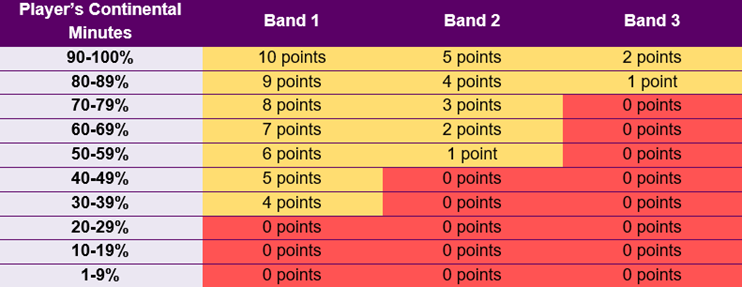
d. Final League Position of the Player’s Last Club: Players will be awarded points based on the final league position of the player’s last club, subject to the following two conditions:
- The player must have been included in the matchday squad for at least one match in the domestic league competition; or
- The player must have played at least 1% of the minutes for his previous club in a domestic cup competition (and such competition must have a qualification route to a continental competition, for e.g., The FA Cup, but not the EFL Cup).
A player will be awarded more points if the finishing position of the player’s previous team falls within a higher domestic band (see 7.b above).
Interestingly, under this category, The FA values promotion to a higher division more than even qualification for continental competitions in some instances.
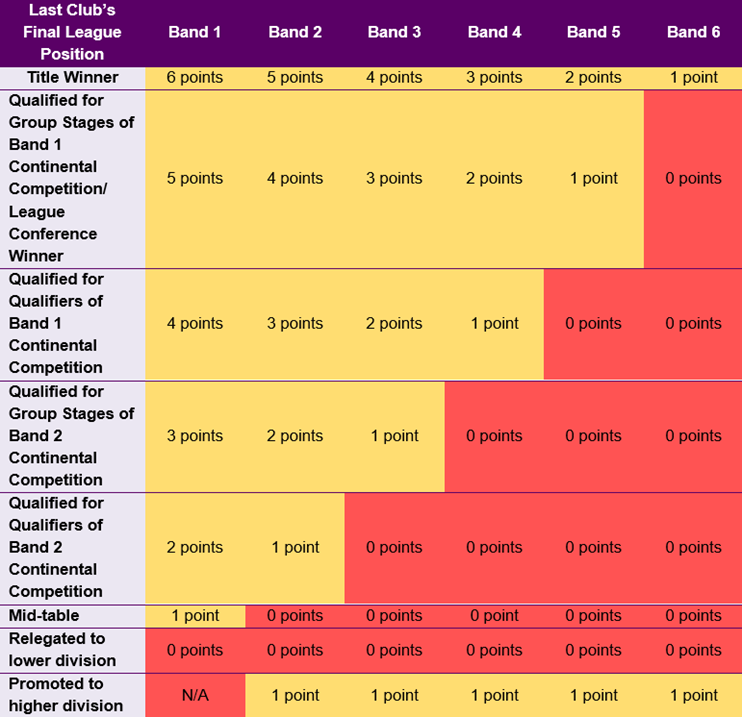
If, for example, a team wins the league title (e.g., La Liga), thereby also qualifying for a continental competition (UEFA Champions League), the player will only be granted the higher of the points he is eligible for, so in this case – only points available for winning the La Liga (6) as opposed to 6+5 points (for also qualifying for the UEFA Champions League).
e. Continental Progression of Player’s Last Club: Players will be awarded points based on how far his team progresses in Continental Competitions, subject to two conditions:
- The player must have been included in the matchday squad for at least one match in the domestic league or continental competitions; or
- The player must have played at least 1% of the minutes for his previous club in a domestic cup competition (and such competition must have a qualification route to a continental competition, for e.g., The FA Cup, but not the EFL Cup).
The FA have assigned ‘Bands’ to continental competitions (different to the Bands 1-6 assigned to domestic leagues). The UEFA Champions League and Copa Libertadores are classified as Band 1, while the UEFA Europa League and Copa Sudamerica qualify as Band 2. All other continental competitions fall under the Band 3 category.
A player will be awarded more points if his team progressed further within a higher banded continental competition (see 7.c above).
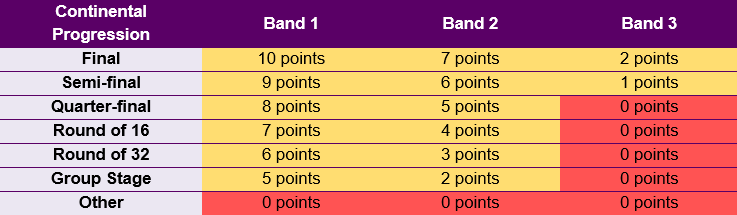
As with the finishing position of the player’s previous team in domestic league competition, the player will only be granted the higher of the points he is eligible for; so for example, if a player’s team reaches the final of the UEFA Europa League (Band 2), the player will only be granted 7 points, and not 7 + 6 + 5 + 4 + 3 + 2 points for every stage of the competition the team would have progressed through, as a result.
f. League Quality of the Transferor Club: Finally, a player will also be awarded points based on which ‘Band’ League (1-6) he is transferring from. Higher points are awarded for Band 1 clubs (12) as opposed to Band 2 (10), Band 3 (8), Band 4 (6), Band 5 (4) and Band 6 (2).
Points under this category will only be awarded if:
- The player appeared on the matchday squad list for at least one match in the domestic league/continental competition; or
- The value of the player’s domestic cup minutes was at least 1% during the 12 months preceding the GBE application.
While previously, youth players were subject to a distinct set of criteria, this is no longer the case. Accordingly, youth players will be subject to the same regime as senior players, whereby they must qualify either by number of international appearances, achieving 15 points against the above criteria or by means of the exception panel procedure.
The GBE Rules do, however, make certain allowances for Youth Players. For example:
- The ‘International Reference Period’ – i.e., the period for determining how many points a player can score for national team appearances – is 12 months as opposed to 24 months for senior players;
- Youth players stand to benefit from additional points if they make their senior club debut during the season in question; and
- Exceptions Panels are more easily available to Youth Players, who do not need a minimum of 10 points, provided the club that is signing them can demonstrate their potential and quality.
Once a player’s application for a GBE is granted by The FA, his club will then proceed to assign the player a ‘Certificate of Sponsorship’ (“CoS”). Only clubs who hold a valid Sponsor’s License may issue a CoS to a player. Premier League and English Football League clubs are eligible for a sponsor’s license.
Within 3 months of the CoS being assigned, the player must then present his GBE and CoS to the UK Home Office to apply for ‘entry clearance’ or a visa.
Previously, under the old visa regime, there were two types of visas that a player could be granted – Tier 2 or Tier 5.
i. Tier 2 visas will be granted for three years or the length of the player’s contract (whichever is shorter); and
ii. Tier 5 visas will be granted for twelve months or the length of the player’s contract (whichever is shorter).
Since October 2021, the Tier 2 and Tier 5 system was replaced by the International Sportsperson (ISP) visa. The current GBE regulations distinguish between long-term and short-term ISPs, with the former replacing the old Tier 2 visa and the latter replacing the Tier 5 visa.
A player can register for a club without a GBE (which may be crucial for those deadline day signings), but before he can play any football (including participation at training and in friendly matches), he must have obtained his GBE, been assigned his CoS, and secured leave to remain in the UK by way of an ISP visa.